bowd·ler·ize
[bohd-luh-rahyz, boud–]
verb (used with object), bowd·ler·ized, bowd·ler·iz·ing.
to expurgate (a written work) by removing or modifying passages considered vulgar
or objectionable.
[bohd-luh-rahyz, boud–]
As a director, there have been several times when I have encountered the challenges of getting a script on its feet in the way it is intended by the authors and the licensing house. In community theatre, you often find yourself being creative with casting – sometimes casting a female in a role written for a male, sometimes doubling up characters, sometimes changing a specified ethnicity and sometimes being creative with the staging so as not to offend audiences with certain sensibilities. These choices are made on what I can most definitely say is a blurred line between creative license and breach of contract. It doesn’t help when you see well-received professional productions bending genders or deviating from the original script.
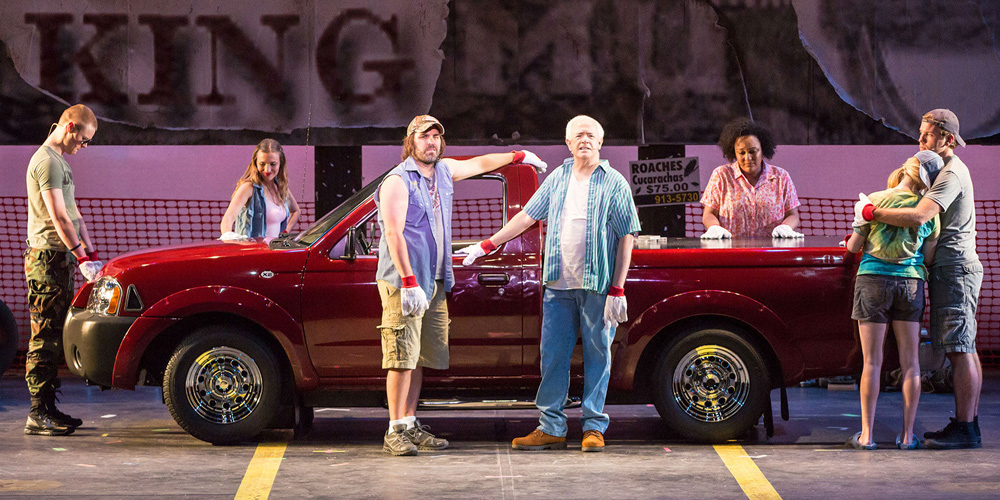
Over the past couple of days, there has been a lot of press about TUTS Underground‘s production of Hands on a Hardbody. The director of that production made the decision to reassign solos, change the order of songs and even cut a song. Further to that, the director then invited the show’s creator to the opening night of the production. What some people might consider to be innocuous changes led to a blog by theatre veteran Howard Sherman and, eventually, a cease and desist letter being sent to TUTS from the licensing house. Meanwhile, in Milwaukee, David Mamet was issuing a cease and desist letter to Alchemist Theatre for casting a male actor in the Oleanna‘s lead female role.
I have to say, the writer in me is very aware of productions that take liberties with what is written on the page. That writer is a constant voice in my head when I am directing a show. I find it is my responsibility to remind actors that the words on the page are the word that are to be spoken, the lyrics the ones to be sung and the intent of the show the one to be presented. Reigning actors in can be a difficult task at times, line flubs and enthusiastic ad libs certainly happen in live theatre, even on Broadway. However, making the conscious choice to deviate from the script is in the hands of the director, the producer and, ultimately, the governing body of that theatre.
For close to twenty years now one of my favorite productions has been Hair, the 60’s love rock musical that recently enjoyed a successful revival on Broadway. When I was in college, deeply moved by friends being deployed to Desert Storm, I relentlessly begged the department head to allow me to direct a production of Hair. He would respond by telling me that the music is great but the book was horrible. I would disagree, grumble and roar and then resign myself to that safety net of department sanctioned productions. Fifteen years later, Diane Paulus would reimagine what was to become the 2009 Tony Award Winner for Best Revival of a Musical. Indeed, that production was greatly altered and, in our war torn present, resonated with modern audiences in the way I suspected it would all those years ago. However, those changes were made with the direct involvement of James Rado, the author of the production. Unfortunately, however, the revival script of the musical is not available for licensing. Instead, community theatres are challenged with staging “The Bed,” seeing Sheila sleep with Claude as a gesture and Berger pounding on Claude’s grave with glow-in-the-dark drumsticks (an ending that I maintain still has great potential).
Ironically, instead of directing Hair, I ended up directing Pippin, a revival that is currently playing on Broadway and was also decorated with a Tony for Best Revival of a Musical. I had seen a production of it a few years back and noted that the ending of the play had changed. Apparently, Stephen Schwartz was never happy with the “Not bad for the end of a musical comedy – ta da!” ending and, in fact, prefers the newer ending where Theo finds himself embarking on a soul-searching journey with the Leading Player and the Players. Again, this is a change that has been made by the author. When I did that production, it was with a female Leading Player, a gender change that Stephen Schwartz endorses, whereas Mamet and his people are deeply protective of his original scripts and changes to gender.
I was recently entertaining the idea of throwing my hat into the ring to direct a show that I think would be a wonderful creative challenge. However, the script calls for an actor of a specific ethnicity and makes references to his cultural background in the script. Knowing the challenges that we have casting ethnically diverse shows in our area, I asked the theatre to speak with the author to find out if we would be given permission to change the character and the lines. When I am a writer, my fingers belong on the keyboard. When I am directing, they do not. I asked that question because I know it is the right thing to do – for myself, for the theatres I work with, for the authors and for the audience.
The important thing to take away here is that the question needs to be asked. Sometimes you’ll encounter a Stephen Schwartz and get the author’s blessing, sometimes you’ll be dealing with a David Mamet and will have to ditch your new approach to the material. Every time you will avoid being the subject of a controversy that ends up on the landing page of Playbill.com.
I realized today that Wicked is to today’s generation what Les Miserables was to mine. Since Les Miserables ran for so long and I find my performance opportunities to be limited to community theatre, dreams of portraying Eponine have given way to the hope that I might one day be cast as Madame Thenardier.
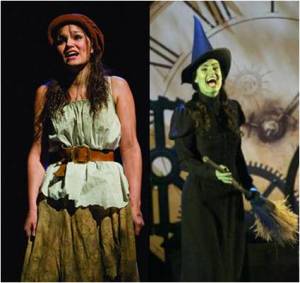
Imagine all those Elphaba wannabes coming to the realization that by the time the rights become available for Wicked the only role they will be suited for will be Madame Morrible.

Funny how in both circumstances the dreamer ends up portraying a madame.
On Sunday, May 18th, I arose earlier than usual. As a believer in signs and with the hindsight I now have, perhaps it was for a reason wholly different than the fact that I had a shit ton of stuff to get done that day. I brushed my teeth, ran a comb through my hair and threw on some clothes I didn’t care about. This morning was going to be messy and I didn’t want to get paint on my skinny jeans or on the shoes I bought to train for the Avon 3-Day in October.
I am not one to make New Year’s resolutions but on January 1, 2014 I made a lot of them. Last year was a difficult year for me so I thought it was a good idea to have a list that would serve as a barometer for all of the positive changes that I wanted to make. One of the resolutions was to form a book club with some of my bibliophile friends in an effort to spend time with people that were voracious readers while, at the same time, forcing myself to read a book or two. On this particular Sunday, our book club, appropriately named Reading Between The Wines, was meant to get together to discuss Lois Lowry’s The Giver. Ever the procrastinator, I double-checked to ensure that the audio version of the book was loaded on my iPod and I headed to the theater to get a few hours of set painting in while finishing up the book for the afternoon’s discussion.
As I was slathering paint on the upstage walls of the theater, I listened to the last hour of The Giver. My phone began to rang as the story reached its conclusion. The lead character, Jonas, was sledding down a hill with the infant Gabriel, leaving behind Sameness and heading toward toward the freedom of Elsewhere, replete with all of the joy of music and the color of twinkling light. This ambiguous ending is simultaneously sad and hopeful. (Yet another moment made oddly clear with hindsight.) Once the story was completed, I picked up my phone to see a missed call and a text from a friend. It said, “Call me.” I have learned two things since the dawning of the age of digital communication: (1) if you receive a text or an e-mail to call someone, you do and (2) it is rarely good news when you make that call.
“Where are you?”
“At the theater, painting the set,” I replied. I could tell in her voice what was coming next.
“Jude passed away this morning.”
And that is when the fog began to roll in. My friend said something about cancelling book club and about getting together at a friend’s house later. She may have said something about seeing me at rehearsal that night. I honestly don’t remember. I hung up and called my husband, who’s first words, “I’m sorry,” which seemed ill suited for me but at the same time, since my husband knew how this news would hit me when it came, ideally suited. Then I called another friend to let her know that Jude was gone. Then I filled the theater walls with loud music, covered them with blood red paint and I cried. I was alone in my church, the whole time thinking of and remembering my friend. I like to think should would have dug that.
Jude had been a presence in our theatrical community well before I happened upon it. To me, she was this enigmatic figurehead of talent that I had yet to experience firsthand, she was The Baker’s Wife, she was Maggie the Cat, she was that charismatic woman who danced with reckless abandon at weddings or the sophisticated lady at the barbecue. But she was not yet my friend. I first really came to know Jude in October 2001, when my husband contracted necrotizing fasciitis (the fancy term for flesh-eating bacteria). She would come to visit him in the ICU every day and hang out in the family waiting room with me and the many friends who came to offer me and our family support and encouragement. When I wasn’t at the hospital, I would be home with my 1-year-old daughter and whichever family members or friends that were staying with me at the time. I remember Jude stopping by one afternoon, sitting casually on my living room floor, reminiscing about time spent onstage with my husband. She brought with her a photo of her and my husband in a production of The Actor’s Nightmare that had hung on her porch. She felt he needed to have it.

While interactions such as these helped me to kn0w her better, I didn’t yet consider her my friend. She was really a friend of my husband’s. Over time, I finally had the privilege of seeing her perform and she was, of course, magnificent. One of those performance included sharing the stage with my husband in Twelfth Night, the production that marked his return to the stage following his year of medical uncertainty. We went out to dinner with Jude and her then husband and it was a delightful evening of French food, fine wine and hanging out with her beautiful dogs in their newly purchased home in Redding. I began to feel that she was someone I would like to spend more time getting to know. Someone I’d like to call friend.
It wasn’t too long after that dinner that we received news that Jude had been diagnosed with breast cancer. All at once she was experiencing what she would later refer to in her memoir, Breast Left Unsaid, as a “Category 5 hurricane” – a life that simultaneously included divorce, the passing of her best friend, both parents taking ill with a topping off of a breast cancer diagnosis. It would have been unrealistic to expect our friendship to become anything more than casual acquaintances as she weathered her hurricane and I gave birth to twins and set about raising three girls under the age of three.
Fast forward to Fall 2008. Jude was in remission and married to the love of her life, my twins were no longer babies and my husband was healthy. The timing found both of us back at our church – the theater – when Jude auditioned for a production of Little Women that I was directing. It was then that I finally felt that I connected with Jude on a more meaningful level. We became friends. We’d share glasses of wine and theater war stories and I realized that the awe I once felt for her had turned into mutual admiration. We were cut from a very similar cloth, she and I. During the run of this production, I was diagnosed with Type 1 diabetes. As I was working to control the ketoacidosis that had set in and juggling needles and insulin vials, she would constantly check in on me. I was so thankful for her concern, very aware of the fact that her father was gravely ill and truly touched that she still made sure to check in on me.
Over the years that followed I was proud to call her my friend. We would attend small dinner parties together, she counseled me through my own breast cancer scare, we would get together and talk about the challenges of starting a theater company and our love of boots, wine, travel and writing. No, I wasn’t a member of her beloved Stumble Upon Crew nor was I referenced directly in her memoir, but we were friends and I felt such a deep connection to her. In fact, as I laughed and cried through her book, I grew angry with myself for not being more “there for her” when she was fighting her battle with breast cancer.
In March 2012 I received an e-mail from Jude’s husband. I was at work and the message told me to call his cell when I had a private moment. As I said before, when you receive a message to call someone, it is never good news. I called him and he told me that Jude’s cancer had come back and that it was Stage 4. He assured me that they were going to do everything they could to fight it – clinical trials, chemo, whatever it took. Jude was going into this with guns blazing. My heart sunk, the tears flowed and, as I did a couple of days ago, I called my husband.
A few weeks later, we got together for lunch and she and I chatted about all the things that mattered: our spouses, our children, family and friends, theater and, of course, our illnesses. She said that she had found a good course of treatment and that she was thankful that her hair wasn’t falling out. I told her that I was on the short list to receive an artificial pancreas as soon as the FDA approved it. I found it almost laughable to reference my illness in the same breath as hers. But Jude understood. Whenever I was in the hospital, Jude was always one of the first people to send me a note asking how I was. I would say that she had no idea how much that meant but, the reality of it is, she did know.
In the all too short years that followed, Jude released her memoir and we proudly attended readings and events as she added writer and activist to her list of talents. Last spring, while my husband and kids were in Barbados, I stayed home to do some home improvement projects and to participate in my first ever 5K in an effort to support Jude and her quest to find a cure. I was literally the last person to cross the finish line but she was there, waiting for me, encouraging me to come to Green Acres and have a glass of wine and a nosh.
As Jude became more ill, the time we spent together was more and more infrequent. At one time, I was included on the e-mail updates pertaining to how she was doing and treatments she was undergoing but as time went on, I was no longer included. I believe that it was because the circle was becoming smaller and I was very aware of the how many lives Jude touched and where I fit into her concentric circles. In January, I sent her a message and told her that I understood that she needed to digest everything with her friends and family first but that I’d love an update. I knew that she didn’t want her illness to define her, yet I was concerned. She responded telling me how much she appreciated being my friend and acknowledged that I understood in a way that many do not. We made plans for lunch.
The next three months were spent arranging dates and then canceling them for one legitimate reason or another. Jude was having procedures or undergoing treatment that would exhaust her or leave her incapable of walking, I would have a cold and wouldn’t to expose her fragile immune system to it or I had a medical procedure and was drugged up. Our Scandal slumber party ended up being a smattering of Twitter statuses about who was more evil: Cyrus or Papa Pope? In short, the timing just never worked for us.
A couple of weeks ago, at a social affair, a mutual friend asked me if I had seen or talked to Jude. Given the numerous cancels and reschedules, I had not. My friend proceeded to give me all of the inside information that she had amassed from her circle that rested closer to the center than mine. I told her to stop. I told her it upset me knowing that she got to see Jude and I didn’t. I told her I was fearful that I would never see her again and that I was deeply saddened by that fact. Fighting tears, I explained to her that I didn’t want to get news second or thirdhand. It seemed time and fate was never on our side, no matter how hard we tried.
A couple of days later, I sent a text to Jude, asking her how she was. Jude was very candid on social media, so I would usually get all of the information I needed from from there. But Facebook and Twitter had fallen into a very telling radio silence. She responded back, telling me that she had stopped chemo and that she was meeting with hospice. I told her that I loved her and that she meant more to me that she would ever realize. I’m glad I got to say that. She told me she loved me. I’m glad I got to hear that. We made plans to have lunch.
A week ago today, as I always did when we had plans, I sent her a text in the morning confirming that we were still on. I received a text back from her husband. “Jude did not have a good night. She needs to cancel. You should reschedule soon.”
And on Sunday she was gone. We never got to have lunch. We never got to have one last word. I never got to hear that laugh one more time. I didn’t want to impose on her. All I wanted to do was bring her a funny picture, sit on her living room floor and talk about Tuscany whilst drinking a glass of wine. I realize, though, that that is about me. Not her.
As I’ve been working through her passing, I keep telling myself that I should have tried one more time and that I should have fought my way harder to be a bigger part of a life already abundant with friends. Should I have just showed up on her doorstep with a casserole and tried jamming it in a refrigerator that I knew was overflowing with food? I didn’t want to insert myself inappropriately or be a nuisance. All I wanted to do was bring her a funny picture, sit on her living room floor and talk about Tuscany whilst drinking a glass of wine. I realize, though, that those are things I wanted, for me. And Jude’s passage from this earthly place was not, and should not, be about me.
Jude left behind an adoring husband, a mother who fought the breast cancer battle twice and won, three siblings who meant the world to her, a stepdaughter to whom she served as Mom2 and a community of friends, tangible and virtual, who loved her very much. There is a tremendous void in so many lives as a result of her passing. The realization I have come to is this: it is not about where I fit in her life, it is where she fit in mine. She made an indelible imprint on my soul and I will be forever changed because of those intertwined moments we shared, however infrequent they may have been.
I am reminded of a scene in Little Women. It is a scene after Beth dies and Jo is in the attic talking to Marmee about the fact that she cannot write, that she is filled with emptiness, that she should have been there and done more for Beth. Believe me when I tell you that I can relate to all of these struggles and have been for over a year now. Last year a show of mine that was meant to have its world premiere was cancelled and, on another project, the producers had replaced me as bookwriter for a show that I had co-written that had received a Broadway option. Jude, as a fellow writer, would always ask me about my writing. I’d tell her that I just didn’t have it in me anymore. I felt defeated by the cruelty of the business. She’d nod and sagely tell me that the time would come and when it did, my writing would be better than ever. My last birthday wish from Jude was this: “Happy happy birthday, darling. Wishing you a wonderful day and year. Drink wine, eat cake, and keep writing.”
As Marmee said to Jo, “But I refused to feel tragic, I am aching for more than pain and grief. There has got to be meaning, most of all when a life has been so brief. I have got to learn something, how can I give her any less? I want life to go on.”
My life will go on, filled with memories of a special woman, and I will start writing again. I will be as truthful in my writing as Jude was in hers and I will spend less time worrying about what others think. As Marmee said to Jo, I will carry on, full of hope. And she’ll be there. For all my days of plenty.
 Chronicles of Controlled Chaos