‘The Normal Heart’ Beats Strong at The Brookfield Theatre for the Arts

Photo Credit: Stephen Cihanek Photography

Photo Credit: Stephen Cihanek Photography

It is a Tuesday night. You pour yourself a glass of wine, fire up the laptop and log on to your favorite social media site. You scroll through post after post about the Ebola virus. Some people make jokes, some criticize the President’s response, some admonish the management of the first cases in the United States and some decry the mistreatment of the health care workers whose life’s work is to eradicate the world of this disease. Fearmongers and realists abound as we attempt to make sense of an admittedly scary situation.

Now replace the word Ebola in the above paragraph with AIDS.

In the early 80s, New York based writer Larry Kramer watched HIV/AIDS rush relentlessly into the lives of the gay community and take hold, only to let go when its victims exhaled their dying breath. The then mysterious disease received little, if any, attention from the media, City Hall, the federal government or the medical community. Even those that seemed to be in immediate danger from the disease ignored early cautionary guidance urging them to stop having sex as a way to prevent transmission of the disease. With no viral media and the minimal coverage relegated to page six, Kramer was prompted to become the co-founder of the Gay Men’s Health Crisis to advocate for the research into the cause of this insidious disease. Hold a mirror up to Kramer’s life, place a pen in his hand and the result is The Normal Heart, the award-winning autobiographical drama now playing at The Brookfield Theatre for the Arts.

Photo Credit: Stephen Cihanek Photograpy

Photo Credit: Stephen Cihanek Photograpy

In recent years, The Normal Heart, which was originally produced at The Public Theater in 1985, has received revitalized critical acclaim with a star-studded turn on Broadway and a film adaptation for HBO. Kramer’s play is a diatribe against the hurdles faced by the gay community in the early 80s and it is infused with anger, frustration and profound sadness. Despite the clear agenda of the script, Kramer crafts intricate and diverse characters, men with subtle differences who paint the common thread of HIV/AIDS with their own personal reactions to the epidemic.

The principal character of Ned Weeks, portrayed with great passion and intricacy by Michael Wright, is the embodiment of Kramer himself. Weeks is deeply committed to his cause and is justifiably angry at the reaction, or lack thereof, to this mysterious “gay cancer” pervading his life and the lives of those around him. He is bombastic to a fault and is never afraid to speak his mind, which sometimes has devastating results. Wright delivers the performance of a lifetime as he navigates the demanding range of emotions penned by Kramer. The rage and pathos demonstrated by Wright are tempered by moments of self-deprecating humor and quiet gentleness, resulting in what can be defined as a tour de force accomplishment.

As Weeks’ lover  and New York Times style reporter Felix, Miles Everett is both gentile and impassioned. In the earlier moments of the play, Everett came off as reserved and uncomfortable, which was perhaps a directorial choice given the awkward first encounters he has with Weeks. As his performance progressed, however, he eased into the role and, once there, delivered some of the production’s most heartbreaking and honest moments.

Vicki Sosbe’s portrayal of the wheelchair-bound Dr. Emma Brookner is terse and ferocious. Based on  real-life physician and early HIV/AIDS researcher Linda Laubenstein, Dr. Brookner is uncompromising in her quest to find the cause of the disease that is ravaging the gay community while issuing warnings to anyone who will listen, be it the government or her patients. Sosbe’s monologue, delivered to a bureaucrat holding the purse strings for grant funds, is blazing and brutally honest, worthy of mid-performance applause.
Photo Credit: Stephen Cihanek Photography

Photo Credit: Stephen Cihanek Photography

Each character in Kramer’s play has a moment where the audience is allowed to peer into the most
harrowing moments of the effect HIV/AIDS had on the gay community. Todd Santa Maria’s poignant depiction of mothers flying into to town to say goodbye to their sons, Kyle Pinto’s off-handed representation of the indifference of Mayor Koch’s administration, Christopher Bird’s self-centered and uneasy approach to sibling acceptance and Michael Reilly’s fearful account of the possibility of government conspiracy, quarantine and loss of insurance are all threads in this most intricate tapestry. Of particular note is J. Scott Williams, as Weeks’ adversarial and closeted friend. His heartrending account of taking his dying lover to see his mother is a devastating recollection of the fear, agony and discrimination experienced by those afflicted with HIV/AIDS.

Andy Okell’s white diorama set-design, reminiscent of the designs used in the Off-Broadway and Broadway productions, served its function as a canvas for the effective projections utilized throughout the production. However, for the majority of the performance, images are not projected, making the flat white walls appear stark. Likewise, Brian Casella’s lighting design lacked color and texture that could have given the set more dimension. Instead, the lighting often left the actors washed out or cast in shadow.

Under David Bass’ detailed and clearly heartfelt direction, The Normal Heart comes off as what it should be: an actor’s play with a glimpse into our recent history when action was necessary. A different course of action may have helped slow the spread of a disease that has resulted in 39 million deaths worldwide since 1981. Larry Kramer was a trailblazer of HIV/AIDS activism, earning his recent inclusion in the Out100 as not only an activist and writer but as a legend.

In our community we often see theatrical pieces referred to as important. While I postulate that all theatre on some level is important, The Normal Heart is, without doubt, one of the most important plays of our time. I urge you to make time in your schedule to see this accomplished interpretation of a rarely produced theatrical gem at The Brookfield Theatre for the Arts.


THE NORMAL HEART runs November 14, 15, 21 and 22 at 8:00pm and November 16 at 2:00pm. Tickets for all shows are $19.99 for General Admission. Students will be admitted for $15. Tickets available at www.brookfieldtheatre.org.

Artistically Speaking

Credit: John Howrey http://bit.ly/JBjIfP

Credit: John Howrey
http://bit.ly/JBjIfP

A couple of weeks ago I was at a dinner party attended by a handful of friends with a commonly shared passion for theatre. Some of us have dabbled in professional theatre but, for most of us, our passions are now relegated to the various roles in community theatre: directors, actors, designers, ad infinitum. Late summer/early fall is the time of year when the local theatres begin to announce their upcoming seasons. Submissions are made, rumors abound and, inevitably, dinner party conversations are had.

In case you didn’t know, theatre people generally are not considered to be of the selfless sort. When seasons are announced you can see the wheels turning as we invariably ask: What roles are there for me? Would I pay money to see my friend in that show? Do I love that show enough to work behind the scenes?

We certainly have opinions about the seasons when they are announced. Some are informed and some are not.

While I postulate that every person responsible for bringing a production “to life” plays a very important role (pardon the pun) in the process, I have in the past year or two come to the conclusion that one of the most critical roles is that of the Artistic Director. According to Wikipedia, the “abbreviated” definition of an Artistic Director is as follows:

The Artistic Director of a theatre company is the individual with the overarching artistic control of the theatre’s production choices, directorial choices, and overall artistic vision.

You can, of course, see a much fuller definition here or Google it to your heart’s content. There are many definitions and interpretations of what an Artistic Director should be.

As someone with a vested interest in local productions and how they are selected, I have some opinions about the role of the Artistic Director and what makes a good one. As every attorney on The Good Wife who has appeared before Judge Patrice Lessner (Ana Gasteyer) knows, every point I make should be preceded with or appended by the phrase: “In my opinion.”

The Artistic Director should ensure that the theatre has a clear artistic vision and should select shows based on that vision. Most theatres have a mission statement that embodies the theatre’s vision and a good Artistic Director should do their best to align the season selection to that vision. Aligning your season to the artistic vision of the theatre can be tricky, especially when a theatre becomes known for specific types or styles of theatre. I know that when discussing area theatres, there are a few that I easily categorize: The Theatre That Does Family Musicals, The Theatre That Does Farce, The Theatre That Does Shows With Gay Themes, The Theatre That Takes Chances, etc. Once a theatre has been labeled that way, it makes it difficult for the Artistic Director to align the vision with the show selection.

The Artistic Director should understand the history of the theatre and the reasons behind past successes and failures. If a theatre is known for producing rock musicals that frequently sell out, they should continue to include them in their season. If a theatre has worked successfully with a director that brings a support staff and a repeat talent pool, they should seek out that director and ask them what project they are interested in doing next. Likewise, if a theatre has produced a show that was poorly attended, they need to understand why. Was it a show about Millennials produced at a theatre whose patronage is comprised largely of Baby Boomers? Did they produce a show about a highly dysfunctional family during the holiday season? I feel it is important to take risks but a theatre must be prepared to offset a potential failure with something that has been typically successful for their space.

The Artistic Director should be aware of what other shows are being done in the area and when. There is a certain thrill that comes from being the first theatre to produce a show after the rights are released. However, “hot commodities” tend to get over-produced right out of the gate. When The 25th Annual Putnam County Spelling Bee was made available, several theatres in my area produced it which, over time, showed diminishing returns. It isn’t just new shows that suffer from repeat performances within a 60-mile radius. How many productions of Les Miserables (Rent, Lend Me A Tenor, Spring Awakening, God of Carnage) did you see in the last year? For a long time, I’ve been saying there should be a symposium of area artistic directors who discuss their plans with the intent to play nicely in the sandbox together. I know that is Quixotic of me to wish for that but the fact remains: as much as I love Les Miserables, I have no interest in seeing four productions of it in one year’s time.

The Artistic Director should leave the business side of the organization to the President or Managing Director. The other important factor that is critical to a theatre’s success is how the business is managed. Typically, the business function is managed by the President or Managing Director and they work in concert with the Artistic Director to run the theatre. While it certainly is a situation where one hand must wash the other to run a theatre effectively, it is important to draw a clear line between artistic and business responsibilities. Managing the administration, business issues, finances, fundraising, board relations, donor relations, publicity and marketing is a task best left to someone other than the Artistic Director. When the line becomes muddied, a theatre’s vision can become compromised.

The Artistic Director should ask their board, their audience and their talent for feedback. The best run theatres maintain a dialogue with their partners. Whether it is through annual meetings, traditional surveys or via social media, it is important to ask for input from the people who invest their time and money in your theatre. If you ask an audience what shows they want to see or give the creative people a chance to tell you what shows they want to be part of, your turnout from auditions to production will be better. Likewise, following up with your board, your audience and your talent after the production gives you a sense of what you’ve done well and where you can improve.

The Artistic Director should read and understand the requirements of every show the theatre is going to produce. The Artistic Director’s methods for show selection vary from theatre to theatre. Some Artistic Directors autonomously select the shows while others rely on a committee to cull the options into a manageable number of options from which the Artistic Director will select. Regardless of the method, it is imperative that the Artistic Director read the show and know the financial and creative requirements needed to produce it well. If your theatre is well-known for family friendly musicals, perhaps producing Urinetown or Bloody Bloody Andrew Jackson would be a bad move. If your theatre doesn’t have an ethnically diverse talent pool, mounting a production of Dreamgirls might not be the best choice. Many of the frustrations a theatre experiences can be avoided if the Artistic Director has a realistic understanding of their selections.

The Artistic Director should have a comprehensive knowledge of their P&L and the cost of producing the shows they select. This is where the partnership between the Artistic Director and the Managing Director is critical. A well-informed Artistic Director has a good sense of what how much money the theatre has in the bank, they know what productions have made money and which haven’t and they have a clear understanding of what it costs to produce a particular play or musical. Historical data and a comprehensive knowledge of the productions you produce are crucial. Little Shop of Horrors is a wonderful musical but if you can’t afford to build or rent Audrey II, the show will fail. Your theatre may love Shakespeare and fall prey to the allure of not having to pay royalties because the show is part of the public domain. However, if you don’t have the talent (in quality or numbers) to mount the production, you are accepting a risk that may not pay off for your venue.

The Artistic Director should select shows based on the talent base that is readily available to them. There are a lot of great plays and musicals available for production. That is a fact. However, I have seen Artistic Director’s become focused on a particular passion project and passion, indeed, is important. However, without the resources to execute the production well, why do it? In community theate there is a limited talent pool from which to select, especially when it is reduced by factors related to gender, age, ethnicity or ability. If a theatre chooses to do Into The Woods, there should be a Musical Director in place that can lead a cast through the intricacies of a Sondheim score. This is also where knowledge of what other theatres are doing is important. If a theatre is looking to produce A Few Good Men, they should be sure there aren’t concurrent productions of 1776 and Twelve Angry Men. (NOTE: Whether it is high school, college or community theatre, the fact remains – men are ALWAYS in demand.)

The Artistic Director should be able to step in as the director of any show they have chosen for inclusion in their season. The adage that the show must go on did not become a theatre staple without cause. Invariably, things go wrong. Among the worst things to happen is to lose your director. This is where the creative talents of the Artistic Director becomes most relevant. When the Artistic Director selects the show, especially in community theatre, in the back of their minds they should be planning for the unexpected. A good Artistic Director has spent time in the director’s chair and should be able to sit in a vacated seat at a moment’s notice. While it is an infrequent occurrence, it does happen. I’ve seen it.

There you have it. My view of the role of the Artistic Director. Now, I know that no rules are steadfast and there are always exceptions. Personally, as a champion of new and original theatre, I find it challenging for Artistic Directors to stray from the war horses and traditional pieces. There are theatres out there that take chances and the ones that do it successfully do so armed with good information, a balanced approach and a willingness to take a chance. For those individuals, I am grateful. I am sure that the audiences and the creative communities are as well.

November Becomes Stresspiration

AngerStresspiration? Yes – it is a word that I made up. So what? It really sums up my continuous and apparent need to add more stress to my life by categorizing it as an inspirational endeavor.

Between October and the end of the year, our family celebrates seven birthdays, eight if you include December 25th’s birthday boy. And that is one heck of a stressful birthday celebration. Then there is travel, holidays, parties, shows to see, concerts to attend and, of course, the subsequent financial ruin that basically leaves me in tears and an anxiety-induced cold sweat by the time my birthday rolls around on January 1st.

Naturally, the first thing I would do is add more to my plate. At least the three things I’ve added won’t cost me more than time and here they are:

NaNoWriMo
I tried National Novel Writing Month last year and failed miserably. Of course, I was directing a play at the time so I pretty much went to work and then to rehearsal, with no time to write. This year, I have a bit of a head start as I am going to be converting my play, A Gift of Undetermined Value, to a novel format. I’m leaving the house in about an hour for a party so I’m already in the hole 50,000 words.

National Diabetes Month
As many of you know, I was diagnosed with Type 1 diabetes right before my 40th birthday. A very big part of me wishes that I had been diagnosed when I was a child because it would be much more incorporated with my lifestyle than it is now. I promise you, if you live forty years without it, the changes are very evident and exceedingly frustrating. That said, I have made it a goal of mine to post about what it is like to live with diabetes, including a week where I do a play-by-play on social media during November to help people understand what it’s like to live with it.

Blog A Day
So, my blog has been pretty neglected. Some friends that didn’t want to commit to NaNoWriMo felt that writing a blog post a day would be less ominous in nature. So I signed up. This is the first post for Blog A Day.

Tomorrow there might be another one.

TheatreWorks Charms With ‘Avenue Q’

AvenueQ Picture

Avenue Q, the unconventional tuner touted as the “Sesame Street for adults” by Robert Lopez, Jeff Marx and Jeff Whitty, is truly the little show that could. It is the musical that snatched the 2004 Tony “Triple Crown” for Best Musical, Best Score and Best Book from Broadway juggernaut Wicked. It is the production that set the trend for downsizing Broadway shows to smaller Off-Broadway houses, allowing it continued life. It is the show that launched the career of Robert Lopez, the 12th person to win an Emmy, Grammy, Oscar and Tony and the first to win all four within the span of a decade. It also boasts being the 23rd longest running musical on Broadway.

Under the meticulous direction of Bradford Blake, TheatreWorks New Milford’s production of Avenue Q is fresh, entertaining and lovable. The musical, whose primary audience grew up learning from puppets and Schoolhouse Rock, employs the conventions of educational television to impart wisdom of a different sort. Who knew in 2003 how timeless the themes addressed in Avenue Q would be? Underemployment, romantic entanglements, accepting differences and over-idealized expectations of our life’s purpose remain at the forefront of so many of our lives, no matter our age. While the subject matter doesn’t sound like fodder for a musical comedy, with the help of clever songs, raunchy humor and those adorable puppets, we find our funny bone is being tickled while our heartstrings are being tugged.

For those not familiar with Avenue Q, the story follows the recently graduated Princeton as he takes up residence in a neighborhood in an outer-outer borough of New York City. With his B.A. in English proudly displayed on his wall, Princeton befriends the humans and monsters of Avenue Q, who share similar uncertainties, challenges, successes and failures in post-college life. Lopez and Marx provide a witty soundtrack that explores the challenges of political correctness with “Everyone’s A Little Bit Racist,” or reminds us that the “Internet Is For Porn.”

Arguably, the stars of the show are the ones covered in felt and fur, and they are manipulated and voiced by a top-notch assembly of talent. As protagonist Princeton and closeted Republican Rod, Mike L’Atrella masterfully synergizes puppet and actor. There are times the movement of puppet and puppeteer are so synchronized that you don’t feel you are watching two separate entities but instead are watching one single character. L’Atrella’s facial expressions expertly animated the otherwize immobile faces of the puppets.

As the altruistic Kate Monster, Patricia McCarthy is sweet, sassy and soulful. Her expressive eyes and childlike pout bring Kate an innocence that makes the X-rated tryst with Princeton during “You Can Be as Loud as the Hell You Want” all the more riotous. Conversely, McCarthy’s rendition of the melodic “There’s A Fine, Fine Line” is memorable and heartbreaking.

Carey Van Hollen and Jamison Daniels expertly manipulate the two-person puppets of Nicky and Trekkie Monster. Moving hands and mouths in concert is a challenge that the actors rise to without missing a beat. As Lucy the Slut, Van Hollen pulls of the right blend of Mae West vocals and Marilyn Monroe sashay. Jamison’s characterization of the lewd Trekkie Monster and good-natured Nicky are perfect. After they introduce their humorous timing as the Bad Idea Bears urging the characters to have just one more Long Island Iced Tea, their mere appearance illicit a chuckle from the audience.

Rounding out the cast are the humans. Glenn Couture brings a nice sarcastic tone to wannabe comedian Brian. As Christmas Eve, Bo Mi Yim masters her one-liners with aplomb and Jasmin Love Barbosa lends the right amount of snark and eye-rolling to child-actor-turned-building-super Gary Coleman.

Musical director Charles Smith leads a stellar five-person band and mention should be made of one of the most musically poignant moments of the evening when L’Atrella, McCarthy and Daniels navigated the tight harmonies of “I Wish I Could Go Back To College.” The band, however, is located in the back of the house and the volume levels sometimes overwhelmed the actors onstage, making it difficult to hear them.

TheatreWorks consistently raises the bar when it comes to the technical aspect of their shows and this production is no exception. Richard Pettibone and Glenn Couture’s homage to that familiar street we know so well is spot on. What appears at first to be a simple apartment building façade effectively transforms into the interior of several apartments, a strip bar, the top of the Empire State Building and a bedroom. Mr. Pettibone and Scott Wyshynski’s lighting design and Suzi Pettibone’s costume design are simple, yet effective. A word of praise should also be mentioned for the stage management crew who helped the actors with what, at times, can be three or four versions of the same puppet character.

In a time when musicals tend to be selected by theatres based on their timelessness, Avenue Q is becoming a permanent fixture in the musical theatre canon. With a bright score and a humorous and heartfelt book, Avenue Q provides an excellent evening of entertainment and it is flawlessly executed by TheatreWorks, proving that they deserved their recognition as the Best Community Theatre in Connecticut.

=========================================================

AVENUE Q runs September 19, 20, 26, 27, 28, October 3, 4, 5, 10, 11, 12, 17 and 18. Curtain time is 8:00pm Friday and Saturday, with 2:00pm Sunday matinees on September 28, October 5 and October 12. Tickets for all shows are $28 for reserved seating. Students and Military personnel with ID will be admitted for $25. Tickets available at www.theatreworks.us or by calling the box office at (860) 350-6863.

Review: The Intimate Side of Bonnie & Clyde

Photo Credit: Richard Pettibone

Photo Credit: Richard Pettibone

The names Bonnie and Clyde, when uttered together, instantly conjure images of twenty-something Depression Era outlaws who became notorious for their string of robberies and murders and, ultimately, their bullet-riddled demise. Parker and Barrow’s lives have been the inspiration for storytellers throughout the years, most notably for Arthur Penn’s film starring Warren Beatty and Faye Dunaway. Recently the duo’s tale was told in Frank Wildhorn’s musical Bonnie & Clyde on Broadway and just last year A&E delivered a two-night miniseries about the pair. On Friday, July 11th, TheatreWorks opened Adam Peck’s play Bonnie & Clyde.

Under the detailed direction of Joe Russo, this two-person play strips away the infamy of the machine guns and fellow members of the Barrow Gang and leaves the audience with a glimpse into the quieter moments that led up to Bonnie and Clyde’s ambush in a Louisiana field under the fire of no less than 167 bullets.

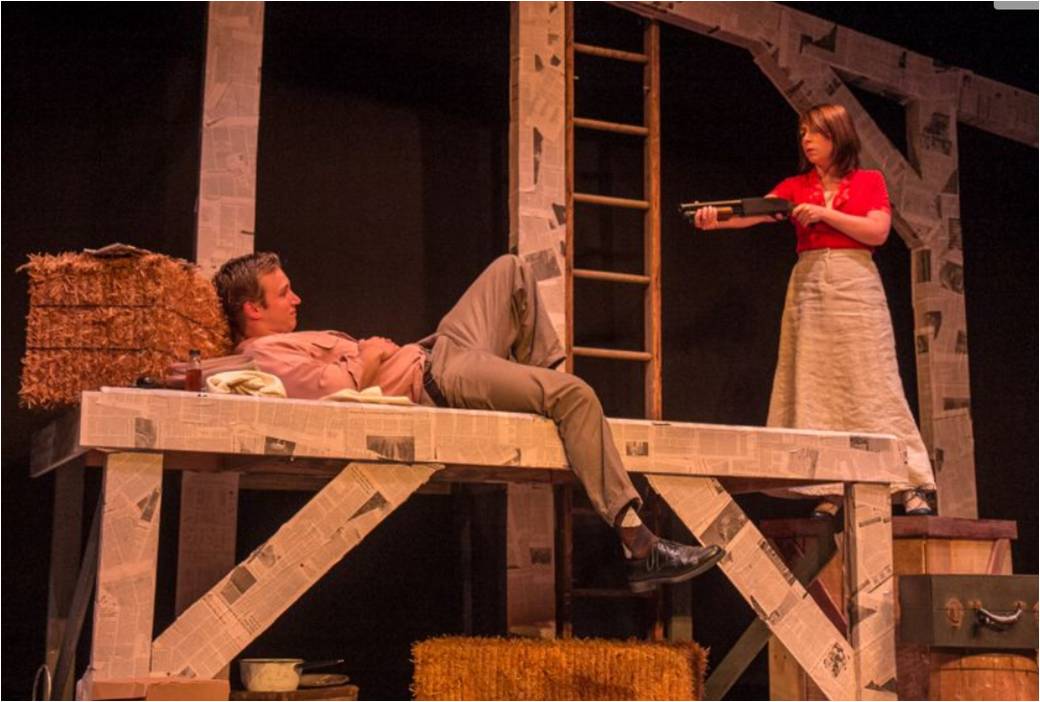
Utilizing a carefully thought out slide show which includes period headlines and press photos, Mr. Russo does an excellent job informing the audience of the time period in which they are about to spend the next hour and fifteen minutes. The visual presentation concludes with grim photos of the titular characters, replete with gunshot wounds to the brain, followed by the sepia tones fading away to reveal a multi-level set with newsprint decoupage, courtesy of Glenn Couture. It is 1934, the country is in the throes of the Great Depression, prohibition was nearing its end, dust storms ravaged the country and entertainment was found in dance marathons and sideshows. We are now in an out-of-the-way barn where Bonnie and Clyde are nursing their gunshot wounds, warming beans over fire in a can and discussing family, dreams, deeds and their eminent capture.

Marilyn Hart delivers a consistent and complex Bonnie Parker. With great ease, she shifts from doe-eyed and innocent to gun wielding and combative. Generally speaking, there are many impressions of Parker. Some feel she was “along for the ride” while others believe her to have been a cold-hearted killer. Hart’s performance embodies these polarizing facets of Parker’s persona and, despite her character’s cold-blooded actions, makes you feel something for Bonnie. Not unlike the way you feel for a good friend who went home with the wrong guy after a too many drinks and a little flirting.

New to the boards, Adam Stordy’s performance as Clyde is solid and unexpectedly good-natured. He gives Barrow an affable quality, not typical of a figure that is commonly thought of as a hardened and bitter criminal. There are gentle moments with Ms. Hart and monologues depicting Barrow’s final moments when Stordy makes you see the human side of a man that is generally dismissed as a monster.

A play based on this couple’s final moments is an intriguing premise. An opportunity to be creative with Bonnie and Clyde’s intimate final moments, however, seems to be missed. Peck’s script often left me wanting something more. Rambling dialogue and factual snippets filled scenes that would have been more effective if there was more action and tension. Perhaps that was the intent of the playwright, to depict a world where “almost” and “what if” are the words that define every moment of every day. With this infamous duo, however, there was an expectation for something more compelling than the script delivered.

Despite a mediocre script, TheatreWorks’ Bonnie & Clyde delivers a captivating glimpse into a notorious couple’s final chapter. There is a simplicity that is offered with this depiction of Bonnie and Clyde that reaches beyond the headlines and gives us a view into their heads. With strong production value, meticulous direction and well-rounded performances, it is a view worth taking in.

My Pain Transformed Into Art (and Vice Versa)

PainArt

When I write anything, I generally spend a fair amount of time noodling it around in my head before I begin the actual craft of stringing words together. Sometimes the noodling takes only a couple of hours, sometimes it last weeks, months, even years. With the help of writing workshops and play writing groups, I’ve been able to spend a little time outside of my comfort zone and try a more extemporaneous writing style. For the most part, however, I need to think the piece through a bit. This particular blog post was conceived at the end of May, on opening night of Bloody Bloody Andrew Jackson, the musical I recently directed at The Ridgefield Theater Barn, and it required the entire run plus a few weeks of noodling to get to today.

I will first begin with a little background about the show. It is an emo rock musical that is based on the life and presidency of Andrew Jackson, the seventh President of the United States. When I first saw the show at The Public Theater in New York I, like most, knew very little about Andrew Jackson, with the exception of the fact that he was on the twenty dollar bill and that he was largely responsible for what is commonly known as “The Trail of Tears.” The musical cleverly utilizes emo rock and youthful angst as a mechanism for conveying the growing pains our Nation and a renegade political leader were experiencing in the early 1800s. It’s snarky, it’s littered with foul language and the humor is offensive. So, naturally, I love it!

Following our first performance, I overheard a friend expressing his opinions to another friend about his distaste for the piece and the casting choices that were made. Coming from someone who is usually very complimentary of the shows that I direct, it stung a bit. When nary a word was mentioned of the show on his Facebook the next day, something he commonly does when he likes a show, it felt like salt being rubbed in the wound. Within a day or two, I was able to shake it off. I get that this show isn’t for everyone.

But week after week the hits kept on coming. People blatantly didn’t clap during the curtain call, expressions of disgust were witnessed over the monitor and friends tried to be positive with phrases like “You’re brave!” or “What a monumental task that must’ve been!” Perhaps the most biting moment of them all was when I crossed paths with a patron as she was leaving the theater and she loudly proclaimed, “That was the most awful thing I have ever seen!”

My poor husband, who was also in the show, had to listen to me dissect and rationalize every comment and reaction. Over and over. Every time we had the conversation, it would end with some variation of “You either love it or you hate it.” And some people did love it. In fact, our worst audience reaction was followed the next day by our best, a performance where some people gave us a standing ovation and others gushed about how hard they laughed. Honestly, I’ve never been at the helm of a more polarizing show and, wow, what an experience that was.

Perhaps one of the reasons I found myself so affected by peoples’ reactions was because I had poured so much of myself into this show. Obviously, there was the hard work and time that went into putting a show together but it was more than that. There was a lot of emotional stuff happening during rehearsals for this show and any time I was angry or upset, I would channel that energy into the show. So when people didn’t care for it, maybe I took it a little more personally that I usually would. Like the lyric from the show says, “It represents how I feel. My pain transformed into art.”

I also realized that this is the first show that I have directed in a long time that didn’t have a string of awards, solid buzz or a fairly universal acceptance as “good theater.” While it extended its run at The Public, the Broadway transfer of the show only ran for 94 performances. Regardless, I was thrilled that the theater chose me to direct the production. I think it its a safe assumption to say that I am a director that is expected to choose productions that are risky, challenging, dark and different. I think it is also safe to say, at the risk of injury whilst patting myself on the back, that I do a good job when I tackle those projects. Some audience members who shared their opinion directly with me said that, while it wasn’t their cup of tea they felt that the direction, the performances, the band and the overall production were solid.

So, why does the criticism of this show hit harder than past less-than-effusive reviews? I think some of it stems from my own need for validation. “Do you like me? Do you really like me?” Every artist who puts their work out there yearns to be praised, to strike a chord somewhere and with someone. If they say they don’t, they are lying. I am constantly saying that we as a community need to explore new territory and take risks on original pieces by new writers. I took that risk and I was invested in it, so why is it that there exists this strange void? Why is it that my art has transformed into, if you pardon the metaphor, pain?

I think, then, of the trailblazers. Stephen Sondheim opened a musical about a vengeful blood-thirsty barber and it grew to become one of the most revered pieces of musical theater of our time. There are always haters. You have to risk being hated in order to find the one or two who love it. Sometimes we succeed. Sometimes we don’t.

I have been told that one shouldn’t respond to critics. That we should believe in what we do, despite what they say. I am still perfecting that skill, always working at it. Do what you love, right? Well, I loved working on this project and the response to it, despite my pondering, has not deterred me in the least.

If I feel hurt, angered or confused by the feedback from the audience or if a patron felt appalled or elated by the production, at least collectively we felt something every time the actors, musicians and audience came together to experience the show. And that, really, is what good art does.

Good art makes you feel something. And feel something we did.

Gripping NEXT TO NORMAL Brings Mental Illness to Light

N2N - Cihanek

When dealing with mental illness in this modern age of instant gratification, we struggle with the notion that there is no magic pill, no simple fix. In Brian Yorkey and Tom Kitt’s Next To Normal, which opened on July 4th at The Brookfield Theatre for the Arts, the Goodman family navigates the rocky terrain of bipolar disorder and grief in what most would consider an unlikely topic for a musical.

The central character of the show, Diana Goodman (Juliette Garrison Koch), has long been suffering from bipolar manic-depressive episodes and swings between “manic, magic days” and “dark, depressing nights,” sometimes carrying her family with her, sometimes knocking them down in the process. Diana’s husband, Dan (Chuck Stango) and their two kids, Natalie (Sydney Coelho) and Gabe (Luke Garrison), struggle to keep in step with Diana as they seek comfort from Diana’s doctors (Keith Guinta) or Natalie’s sweet, stoner boyfriend Henry (Matt Madden).

The winner of the 2010 Pulitzer Prize for Drama, Next To Normal is under the deft direction of Michael Burnett, who has proven time and again that challenging his performers and his audience with difficult subject matter yields powerful results. The expository first act moves swiftly and sets you up perfectly for a gut-wrenching second act.

As Diana, Juliette Garrison Koch takes on a physically, vocally and emotionally demanding role with great aplomb. Easing between the quiet, tender moments to the wild, frenzied ones, the audience genuinely feels the torture of Diana having to choose between a drug-induced catatonia and a medication-free instability. Ms. Koch owns the stage during some of the bigger, belted numbers but the moments when the grief gently bubbles to the surface are her most memorable. During her anguish-filled rendition of “How Could I Ever Forget?” she grabs onto your heart and grips it relentlessly until the final curtain.

Sydney Coelho’s portrayal of Diana’s troubled teenage daughter Natalie is at once explosive and poignant. Her powerful vocals shine in the character’s signature song “Superboy and the Invisible Girl” while the gentler moments when she acknowledges her fear of becoming like her mother are heartbreaking and unforgettable.

Luke Garrison, as Gabe, drifts in and out of the shadows with confidence, inserting himself into the action with a menacing rock-star quality as he constantly tugs at the very fiber holding the family together. Garrison’s strong voice and youthful presence during his solo “I’m Alive” perfectly exemplify this charismatic character.

Chuck Stango brings great heart to the role of Dan, Diana’s faithful and determined husband, desperate to fix what is broken. Newcomer Keith Guinta delivers a crisp take on Drs. Fine & Madden, with effortlessly clear vocals. Matt Madden is charming as the patient and quirky Henry.

Music director Nsangi Kariamu expertly leads a five piece orchestra and vocal director Diane Lapine guided the cast through Kitt’s complex score. Kariamu is able to musically direct the cast through the production from a location upstage, a position that can be challenging for both performers and orchestra alike. The orchestra is buoyant, finding moments where the musical shifts evoke more emotional response than some of the spoken scenes, a sign of a well-crafted score meeting flawless execution.

Laura Baxter’s set design, with its similar-yet-assymetrical “N” shaped windows and floating white platforms against a black void, perfectly represents the imbalance of the Goodman household. Justin Morgan’s lighting design lends to the rock concert feel of Diana’s internal monologue and gradually and subtly becomes devoid of color as her mind is emptied of troubling memories. Wendy Yung’s sound design was a little uneven at the beginning of the show, making it difficult to hear certain lyrics, but seemed to resolve itself throughout the course of the evening. From the manic reds to the post-ECT greys and blues, Meg Jones’ costume design is well thought out and aptly reflects Diana’s mental state throughout the show.

In a time when commodity and jukebox musicals pervade the landscape of the modern musical, it is important that original pieces that break the mold are given life in an accessible and affordable setting. Next To Normal is a significant musical for our generation and it is beautifully and lovingly staged at The Brookfield Theatre for the Arts.


Next To Normal runs at The Brookfield Theatre for the Arts, 184 Whisconier Road, Brookfield. Friday, July 4-Saturday, July 26, 8 p.m. $20-$15. 203-775-0023, tbta@brookfieldtheatre.org.

Observation for Oinbones #2

Continuing with the Ernest Hemingway exercise…

KidsSpider

SPIDERS

I don’t really have a fear of spiders. Not to say that I have a desire to cuddle up next to them and read them bedtime stories but they don’t make me scream like a girl. In my household, I am usually the one that ends up killing the eight-legged intruder and flushing him down the toilet.

Several years back, my sister was in a near fatal car accident. After having too much to drink and an argument with her boyfriend, she plowed her Chevy GEO into a parked Volvo while traveling at 70mph. I was a college senior at a small university in Ohio and spent any break from my studies making the trip back to Connecticut to see my sister, whose rehab was spent residing in the same room as the famed Central Park Jogger.

I had just finished directing the first and only mainstage production in the history of the university, Pippin, and brought the video for her to watch. She watched the video, through vacant eyes and with minimal reaction. Afterward, we got her back into bed and my father, still a smoker, went out for a nicotine fix while I attempted to make conversation with my sister. Since she had a tracheotomy, she was unable to speak. She was, however, able to write and made jokes about hawking loogies through her tracheotomy tube at people that pissed her off. We laughed. Then she drew a picture of a spider.

And another.

And another.

She asked where our father was.

Another picture of a spider.

I asked her why she was drawing pictures of spiders. And she told me she was drawing them so that I would go away.

Away.

Away.

Away.

She kept writing that word until there was no more room on the paper, onto the walnut veneer of the hospital tray table.

I will never think of spiders in the same way.

A Raised Glass & A Word for Papa


EHChicago

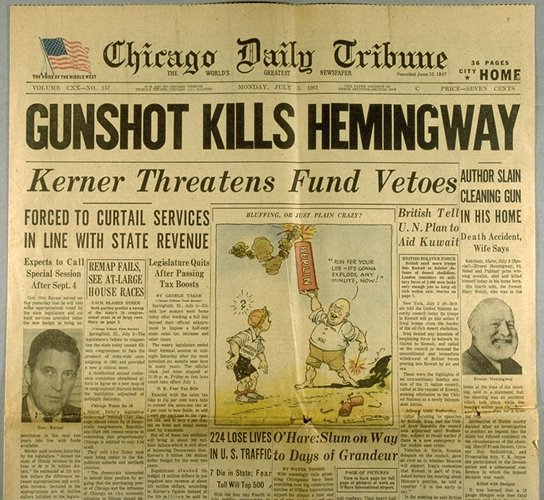
This post is not about my father. It is about one of America’s most notable literary figures – Ernest Hemingway. 53 years ago today, Ernest Miller Hemingway found his way to his gun cabinet and discharged one chamber of his double-barreled, 12 gauge  shotgun and ended his magnificent career as a writer and, more importantly, shut the light out on an extraordinary life.

I am in the process of researching a musical based on this iconic figure. Believe me when I say the landscape of material is wide and deep. Finding the proper way to approach this intricate life is not easy. I do not envy the biographers and scholars the task they’ve had in documenting this complicated man and his body of work. I am fortunate to personally know one of the foremost authorities on the subject but I’m saving that “Phone A Friend” lifeline in my research for another time.

I’ve been reading a book by Arnold Samuelson, a writer-come-hobo who managed to find himself on Hemingway’s doorstep in 1934 and then subsequently found employment and tutelage under Papa himself. What started out as a few questions about writing ended up as a year on Pilar as a deckhand/night watchman and as a writing student of Papa’s.

In Samuelson’s memoirs, he recalls some advice he received from the Master: “Every day describe something you’ve seen so that the reader can see it and it becomes alive on paper.  That’s the way Flaubert taught Maupassant to write.  Describe anything—the car on the dock, a squall on the stream or a heavy sea.  Then try to get the emotion.

As a tribute to EH and as an attempt to transfer my daily observations into words, I intend to write every day about something I’ve seen, no matter trivial. So that the reader can see it and so that it will come alive.


Mirror

REFLECTION

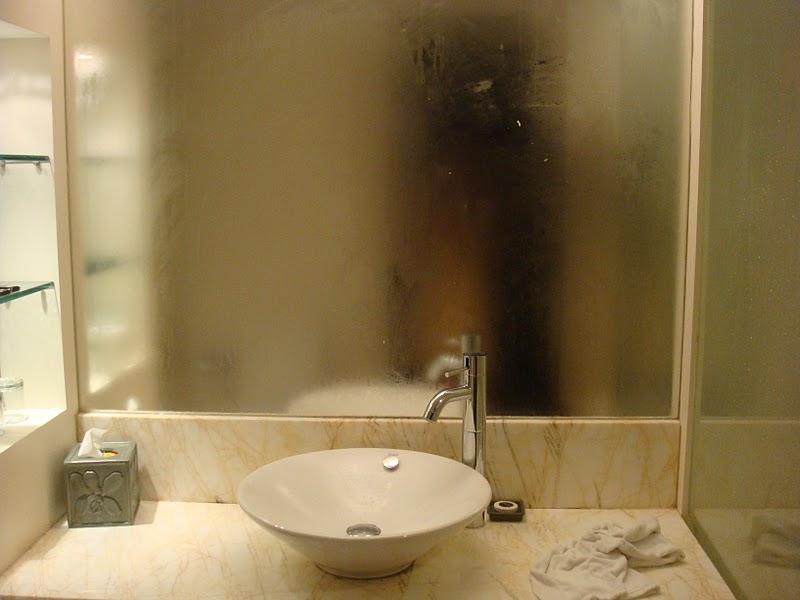
The air is hot and moist as the impending storm threatens to alter everyone’s weekend plans. The steam from my shower still lingers in the air as I stand in my bra, not quite ready to cover my damp skin with my Old Man and the Sea t-shirt. I wipe the fog from the mirror and stare at the reflection. Pale white skin, tubes and wires navigating needle scars that permeate a gut that hangs ever-so-slightly over my waistline. I am reminded of the second false start to my fitness regimen and cannot decide whether or not to accept defeat or refuse it. The snarky voices of the cast of MTV’s Girl Code echo downstairs, imploring their audience to embrace their bodies and love themselves for who they are. I laugh. Not because it is funny but because it isn’t. No man in my life has ever told me that I am beautiful. Sure, I was likely told that I looked beautiful on my prom night or on my wedding day but being told that you look beautiful is different than being told you are beautiful. I’ve been call intelligent, talented, amazing even, but never beautiful. My mind wanders back to my reflection. I grow weary of my it and hurriedly cover myself, despite the thick air.

From Director to Critic

Criticism

I was recently asked to join the OnStage Critics Circle as a contributing columnist. The invitation really couldn’t have come at a better time. I was about to wrap up directing Bloody Bloody Andrew Jackson and I had made a solemn vow to myself that when that show was done and dusted I would devote time every day to writing or, at the very least, do something that would further the development of one of my writing projects. Since we struck the show on Sunday, I have definitely lived up to the promise in some way or another.

It is an interesting segue, to say the least. I have directed at or been involved with all of the Connecticut theaters within a 20 mile radius of my home and, in some instances, beyond that radius. Through my active involvement in our theater community, I have have developed a fairly broad familiarity of the theaters, the people who run them and the artisans that bring their seasons to life. As such, I was a little hesitant to step out of the director’s chair and pick up the pen of the critic.

I have put some thought into the last 20 years in our community and how the presence of the theater critic has faded. When I first started working in the area, there were a lot of journalists, then of the ink and newsprint ilk, who attended our productions. We would wait with bated breath for their words of praise or damnation and it was, despite our contribution, a part of the process of bringing our art to life. As a result of the digital age, the circulation of printed news is dwindling and so are budgets. Not surprisingly, the arts are the first to go and in this case, published theater reviews in our neck of the woods have become few and far between.

I hesitated to take on the role of critic because of the personal relationships that I have with the theaters and the people that run them. Chances are that every show I will see will feature an actor or two I’ve worked with in the past, a director with whom I am familiar and will be at a theater that is known to me. I have concerns about where to draw that “conflict of interest” line.

After much thought, though, I have come to this conclusion: theatrical criticism is a dying art. Even the likes of Ben Brantley and Michael Riedel are losing their previous luster and sought after praise, so I truly feel there is a need in our community for opinion. While I am certainly nowhere near as accomplished the critics associated with New York theater, I am certainly a person who has both opinions and a pretty comprehensive understanding of the art. And I’m not a bad writer either. Bottom line, I feel I am qualified.

As for the personal relationships, I have seen local critics share their thoughts while they remain involved in the theater as actors or directors. So, as far as reviews that I will contribute to OnStage Critics Circle, I will follow these guidelines: (1) I will not review a show at a theater during a season in which I am slated to direct, (2) I will not review a show at a theater where I am serving as a member of the Board or on a Committee and (3) I will not review a show featuring my husband or another family member in the cast. I also promise to be as honest and fair in my reviews as possible, I will not review a show that I haven’t seen from beginning to end and I will accept invitations to review any show, regardless of my personal theatrical preferences. I believe those guidelines will serve to be a fair and reasonable foundation upon which I will place this next building block in my theatrical career.

So, with that, I will fold up my director’s chair and take a seat in the house, eager to see what the days ahead will bring. Break a leg, my friends, and I’ll see you at the show!